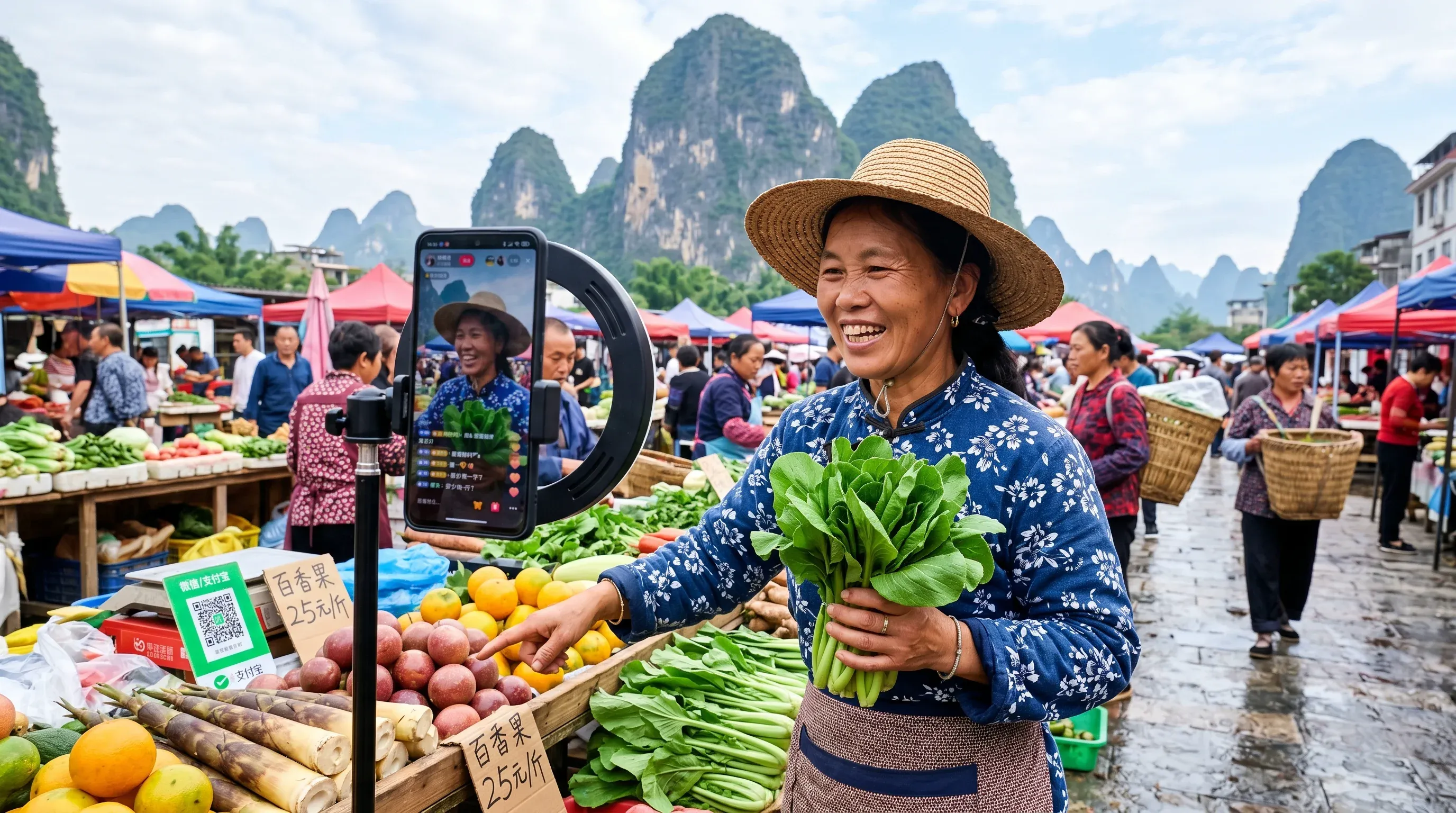
Yangshuo's Digital Village: When Farmers Meet E-Commerce
Yangshuo farmers work rice paddies by day and manage Taobao stores by night. This is rural China's digital revolution, where traditional agriculture meets live-streaming, QR codes, and direct-to-consumer sales. A side of Yangshuo most tourists never see.
Content researched and verified against official local operators and regional tourism sources.
The Scene That Surprises Visitors
You cycle through a remote Yangshuo village. An elderly farmer tends pomelo trees. Next to him: a smartphone on a tripod, live-streaming to 500 urban customers in Shanghai and Beijing. He's demonstrating how to select ripe pomelos while taking orders via WeChat.
This isn't a novelty, it's the new normal. China's rural digital economy has transformed village life in ways that contradict Western assumptions about "backward" countryside. Yangshuo farmers often know more about e-commerce logistics than city dwellers in other countries.
For tourists, this creates a fascinating paradox: You come to Yangshuo seeking "authentic traditional villages," and you find them, but the 70-year-old farmer you photograph also runs a successful online business with better digital skills than many Western small business owners.
How Yangshuo's Rural E-Commerce Works
1. Taobao & Pinduoduo Stores (淘宝 & 拼多多)
Taobao (淘宝 - Táobǎo) and Pinduoduo (拼多多 - Pīnduōduō) are China's largest e-commerce platforms. Farmers create storefronts to sell produce directly to urban consumers, bypassing traditional middlemen who previously took 40-50% margins.
What They Sell
- • Pomelos (柚子): Famous Guangxi variety, ¥15-25 each
- • Kumquats (金桔): Seasonal winter fruit
- • Sweet potatoes (红薯): Organic, locally grown
- • Handmade rice wine (米酒): Traditional fermentation
- • Dried persimmons (柿饼): Processed in autumn
- • Hand-painted fans (扇子): From Fuli artisans
The Process
- 1. Farmer photographs products with smartphone
- 2. Lists on Taobao/Pinduoduo with descriptions
- 3. Customers order via app
- 4. Farmer harvests fresh (same day)
- 5. Packages and brings to local courier(快递)
- 6. Delivery to customer (2-3 days nationwide)
Economic Impact: Farmers keep 80-90% of retail price vs. 50-60% selling to wholesalers. A successful Taobao farmer can earn ¥50,000-100,000 annually from fruit sales alone, double or triple traditional farming income.
2. Live-Streaming Commerce (直播带货)
Live-streaming e-commerce (直播带货 - zhíbō dàihuò) exploded in rural China 2018-2024. Farmers broadcast live from fields, demonstrating produce freshness and building customer trust through personality and transparency.
Platforms Used
- • Taobao Live (淘宝直播)
- • Douyin (抖音 - TikTok China)
- • Kuaishou (快手)
- • WeChat Channels (微信视频号)
What They Show
- • Harvest process (tree to box)
- • Taste tests cutting fruit
- • Farm tours ("See my orchard!")
- • Packing demonstration
Sales Strategy
- • Flash sales (限时优惠)
- • Volume discounts
- • Q&A with customers
- • Building loyal following
"My father is 68 and streams on Douyin three times a week. He makes more from pomelo sales online than he did farming ALL crops for 40 years combined. He learned smartphone skills in one month."
3. WeChat Business Groups (微信商业)
WeChat (微信 - Wēixìn) isn't just messaging, it's China's digital economy platform. Farmers use WeChat groups to sell to repeat customers, organize community buying, and provide customer service.
How It Works
- • Farmer creates WeChat group (500 members max)
- • Posts daily photos of available produce
- • Customers order via chat message
- • Payment via WeChat Pay (微信支付)
- • Ships via courier or local delivery
Customer Relationships
Unlike Taobao (anonymous transactions), WeChat business builds personal relationships. Customers become "friends" (好友 - hǎoyǒu), ask about farmer's family, share recipes, and return seasonally.
This mirrors traditional market relationships, but scaled digitally nationwide instead of limited to local town.
What Made This Possible?
Yangshuo's digital village economy didn't appear overnight. It required specific infrastructure andtiming:
Physical Infrastructure
- •4G/5G Coverage: Rural Yangshuo got reliable mobile internet 2015-2018. Critical for live-streaming.
- •Solar Panels: Government subsidies 2016-2020 brought electricity to remote farms, powering WiFi routers and device charging.
- •Logistics Networks: SF Express, ZTO, and other couriers established village pickup points. Farmers can send packages from any village.
- •Paved Roads: Tourism infrastructure improvements (roads to scenic spots) also connected farms to courier hubs.
Digital Ecosystem
- •Smartphone Penetration: Affordable Chinese smartphones (Xiaomi, Oppo, Vivo) cost ¥800-1500, one week's income. Nearly 100% of working-age farmers have smartphones by 2024.
- •Mobile Payment: Alipay and WeChat Pay eliminated need for bank accounts. Farmers receive payments directly to phone.
- •Government Training Programs: 2017-2022 rural e-commerce training sponsored by Alibaba and local government taught farmers platform skills.
- •Youth Migration Reversal: Young people returned from factory jobs to help parents with online businesses, bringing digital skills back to villages.
What This Means for Travelers
1. "Traditional" Villages Are More Modern Than You Think
When you cycle through Yangshuo countryside and see farmers hand-planting rice, you might assume they're stuck in poverty. Many are not. That farmer with a water buffalo also has a Taobao store with 5-star reviews and more digital marketing skills than most Western small businesses.
2. You Can Buy Directly From Farmers
If you speak some Chinese or have a local friend translate, you can add farmers on WeChat and buy pomelos, kumquats, or other produce directly. They'll ship to your hotel or even internationally (some farmers).
3. This Explains Why Villages Still Function
In much of rural China, young people migrated to cities for factory work, leaving villages with only elderly residents. Yangshuo is different. Between tourism jobs and e-commerce income, young people can stay in villages and earn comparable (or better) money than city factory jobs. This preserved community structure that collapsed elsewhere.
4. The Paradox of Development
You come to Yangshuo seeking "untouched rural life." You find rice paddies, water buffalo, hand-farming, all the visuals. But the underlying economy is thoroughly modern: mobile payments, e-commerce, logistic networks, 5G streaming. This is the paradox of 21st-century rural China: traditional methods powered by digital infrastructure.
Why Yangshuo's Digital Economy Matters
Yangshuo's rural digital economy is a unique case study in development that challenges Western assumptions about "backward" countryside vs. "advanced" cities. It shows that:
- 1.Rural doesn't mean disconnected: With smartphone + internet, location becomes less relevant for commerce.
- 2.Traditional and modern can coexist: Farmers use hand-farming methods (better quality, tourist appeal) while selling via cutting-edge e-commerce.
- 3.Digital literacy isn't age-dependent: When economic incentives are strong enough (doubling income), even elderly farmers learn new technology.
- 4.Tourism created enabling conditions: Infrastructure built for tourists (roads, electricity, internet) enabled e-commerce that now rivals tourism economically.
For visitors, this adds depth to your Yangshuo experience. You're not just seeing "traditional China", you're witnessing a fascinating hybrid society that's redefining what "rural" means in the digital age.
Explore More About Modern Yangshuo
Understanding Yangshuo's digital economy is just one piece of the modern rural China story. Discover more about how the region evolved.