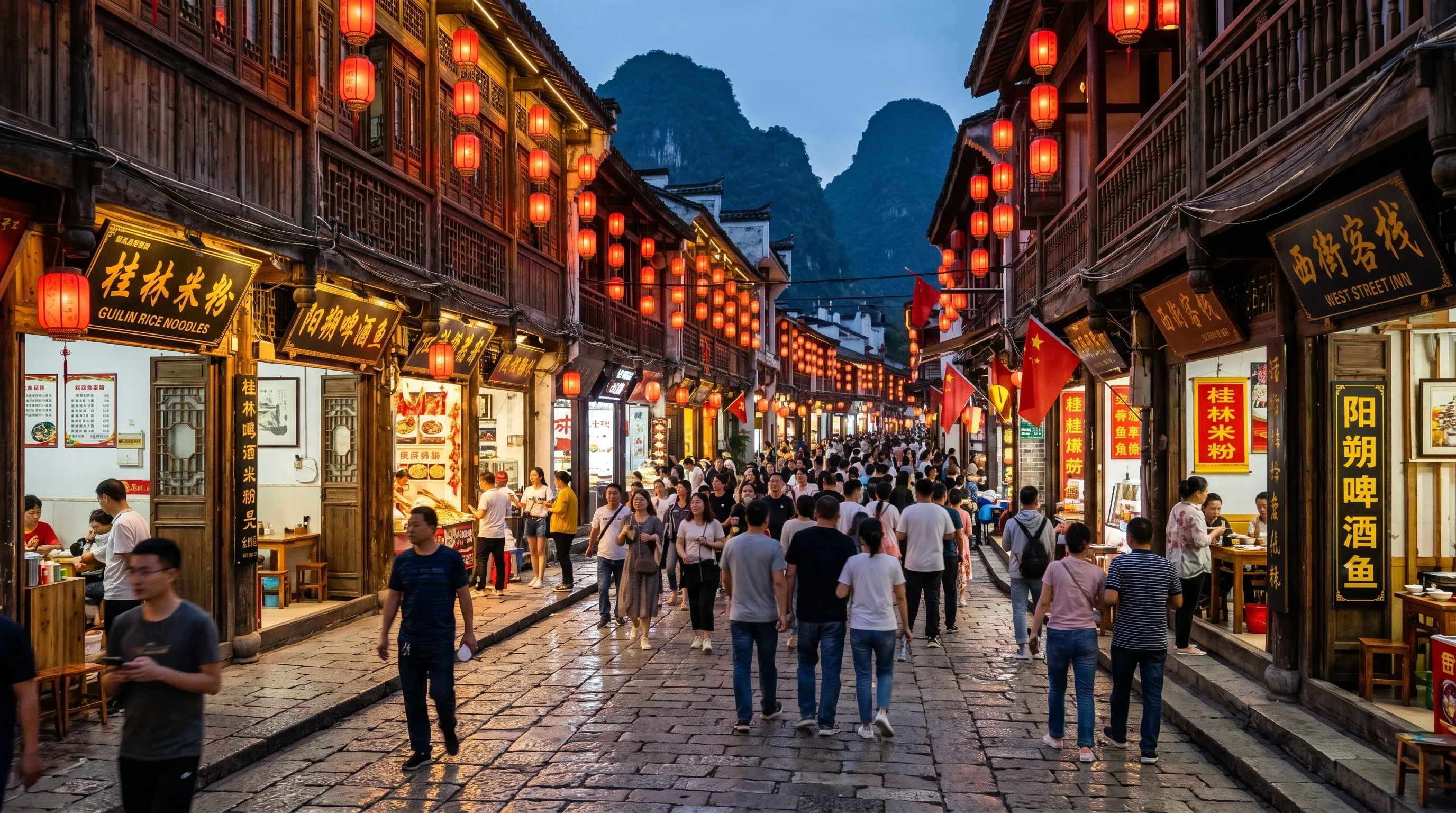
Yangshuo Through the Decades: A Tourism Transformation
From forgotten karst village to the 20 RMB banknote icon. How Yangshuo went from hosting a handful of backpackers in the 1980s to welcoming millions of tourists annually. This is the story of China's tourism evolution in one remarkable town.
Content researched and verified against official local operators and regional tourism sources.
When was West Street, Yangshuo's oldest street, founded?
West Street's origin as Yangshuo's oldest street dates to 590 CE (Sui Dynasty, Kaihuang year 10), when the county administration was first established here, consistent with the commonly cited "1,400+ years of history" framing. This deeper history predates the tourism-era timeline below, which begins with the backpacker discovery of the 1980s. Sources (secondary, two independent): Baidu Baike and Guilin Daily (2024-03-07), accessed 2026-07-23.
The Backpacker Discovery Era
Remote agricultural village • First Western travelers • Primitive infrastructure
The Before Times
Before the 1980s, Yangshuo was an isolated farming community surrounded by karst mountains. Most residents had never seen a foreigner. The town consisted of a single dirt road (now West Street), a few stone houses, and rice paddies extending to the river.
Everything changed when China began opening to Western tourism in the early 1980s. The first backpackers arrived from Guilin, stumbling upon this hidden valley almost by accident. Word spread through the Southeast Asia backpacker trail: there was a magical place in southern China with limestone peaks, bamboo rivers, and almost no tourists.
What Yangshuo Looked Like
- • Population: ~15,000 (mostly farmers)
- • One dirt road (West Street)
- • 2-3 basic guesthouses
- • No international phones or mail
- • Electricity unreliable
- • Total foreign visitors: hundreds per year
Early Traveler Experiences
- • Stayed in village family homes (¥5/night)
- • Ate home-cooked local food
- • Cycled on unmarked dirt paths
- • Swam in pristine Li River
- • Exchanged black-market currency
- • Communicated via gestures (zero English)
"We arrived in Yangshuo in 1984. There was one street, one restaurant, and locals had never seen blonde hair. Children followed us everywhere. It was the China everyone dreams of finding."
National Recognition: The 20 RMB Banknote
Featured on Chinese currency • Domestic tourism begins • Infrastructure expansion
The 20 Yuan Banknote Phenomenon
In 1999, the People's Bank of China released a new 20 Yuan banknote (RMB ¥20) featuring a landscape from Xingping (兴坪 - Xīngpíng), a small town 30 km from Yangshuo along the Li River. The image showed karst peaks reflected in the river, instantly recognizable to anyone who'd seen Yangshuo's landscape.
This transformed Yangshuo overnight. Every Chinese person carried this landscape in their wallet. The banknote became a symbol of China's natural beauty, and visiting the "20 Yuan view" became a national bucket list item. Domestic tourism exploded.
1990s Changes
- ✓ West Street paved (no longer dirt)
- ✓ First hostels and budget hotels opened
- ✓ English menus appeared
- ✓ Rock climbing emerged (1992-1995)
- ✓ Impression Liu Sanjie show opened (1998)
- ✓ First domestic tour groups arrived
What Stayed the Same
- • West Street still just one street
- • Rice paddies dominated landscape
- • Water buffalo everywhere
- • Most villages untouched
- • Locals still primarily farmers
- • No international hotel chains
Photo Pilgrimage: Today, visitors still flock to Xingping to photograph themselves holding a 20 RMB note in front of the exact view on the banknote. It's become one of China's most iconic tourist photos.
Growth Within Limits
International tourism grows • Infrastructure improves • Geography constrains sprawl
The 2000s brought steady growth, but Yangshuo's geography prevented the massive sprawl seen in other Chinese tourist cities. The karst mountains physically blocked development in most directions. West Street remained the commercial center, expanding vertically (taller buildings) rather than horizontally.
Tourism Growth
- • Annual visitors: 1-2 million
- • Mix: 70% domestic, 30% international
- • Average stay: 2-3 days
New Developments
- • Bamboo rafting commercialized
- • First Western-style cafes
- • Improved roads to Guilin
Lost Authenticity
- • West Street fully commercialized
- • Li River swimming prohibited
- • Souvenir shops proliferate
The "Still Authentic" Debate
By the mid-2000s, travel forums were already debating whether Yangshuo was "too touristy." But compared to what would come in the 2010s, this was still a relatively quiet era. You could cycle into villages and encounter farmers who'd never interacted with tourists. The commercial zone was limited to West Street and a few surrounding blocks.
The Mass Tourism Explosion
High-speed rail • Domestic middle class growth • International chains arrive
The Tipping Point: 2013-2016
The completion of high-speed rail connecting Guilin to major cities (Guangzhou, Shenzhen, Hong Kong) made Yangshuo accessible for weekend trips. China's growing middle class had disposable income and leisure time. What had been hundreds of thousands of annual visitors became millions.
Major Transformations
Number of guesthouses grew from ~200 to over 1,000. International chains (Hilton, Park Hyatt) opened luxury properties. Airbnb listings proliferated.
KFC, McDonald's, Starbucks opened on West Street. Western-style restaurants outnumbered traditional Chinese eateries on main streets.
West Street pedestrianized. New parking structures built. Ten Mile Gallery road widened for tour buses.
Alipay and WeChat Pay became universal. QR codes replaced cash. WiFi ubiquitous. Online booking standard.
Economic Boom vs. Cultural Loss
The 2010s brought unprecedented prosperity to Yangshuo. Farmers' children moved from agriculture to tourism jobs. Guesthouse owners became wealthy. Modern amenities arrived.
But something was lost. By 2018-2019, travel bloggers commonly wrote "Yangshuo is over-touristed" and "Don't visit Yangshuo anymore." West Street became what backpackers had feared: a commercialized tourist trap indistinguishable from theme parks elsewhere in China.
Post-Pandemic Reset & Digital Villages
Sustainability awareness • Rural e-commerce • Smart tourism • Dual identity emerges
The 2020 pandemic brought a pause, then a reset. Yangshuo in 2026 exists in dual states simultaneously: West Street and main attractions are thoroughly commercialized modern tourism zones, while villages 2km away continue traditional agricultural life, albeit with smartphones and e-commerce.
The Commercialized Yangshuo
- • Annual visitors: 8-10 million (pre-pandemic levels returning)
- • West Street: 24/7 commercial zone, international dining, bars, clubs
- • Yulong River: Regulated bamboo raft industry (set routes, prices)
- • Impression Liu Sanjie: Nightly shows for thousands
- • Rock climbing: Professionalized with guide companies
- • Hotels: 1,500+ properties from hostels to luxury resorts
The Digital Village Yangshuo
- • Farmers use Taobao, Pinduoduo for direct sales
- • Live-streaming pomelo harvests to urban customers
- • Solar panels power rural internet connectivity
- • Youth returning to villages with e-commerce skills
- • Traditional farming continues but supplemented by digital income
- • Villages preserve culture while embracing technology
2026 Reality Check
Today's Yangshuo is neither the pristine village of backpacker dreams nor a soulless tourist trap. It's a complex hybrid: modern tourism infrastructure coexists with authentic rural life, separated by just a few hundred meters.
Visitors who only visit West Street, Yulong River piers, and major viewpoints will experience "tourist Yangshuo." Those who cycle unmarked paths, wake at dawn, and explore villages beyond tour bus routes will still find the authentic landscape that appeared on that 20 RMB note, just with better WiFi.
What Yangshuo's Evolution Teaches Us
Tourism Brings Prosperity
Local incomes increased 10-20x. Children gained access to education and opportunities their parents never had. Infrastructure improved quality of life for residents.
Geography Matters
Yangshuo's karst peaks prevented limitless sprawl. This accidentally preserved the very landscape tourists came to see. Other cities without natural barriers lost their character completely.
Dual Realities Can Coexist
West Street can be a commercial zone while Jiuxian Village remains agricultural. Modern tourism and traditional life coexist, separated by a short bicycle ride.
Experience Both Yangshuo's Past and Present
Understanding Yangshuo's history helps you appreciate what you'll find today, and where to look for authentic experiences.