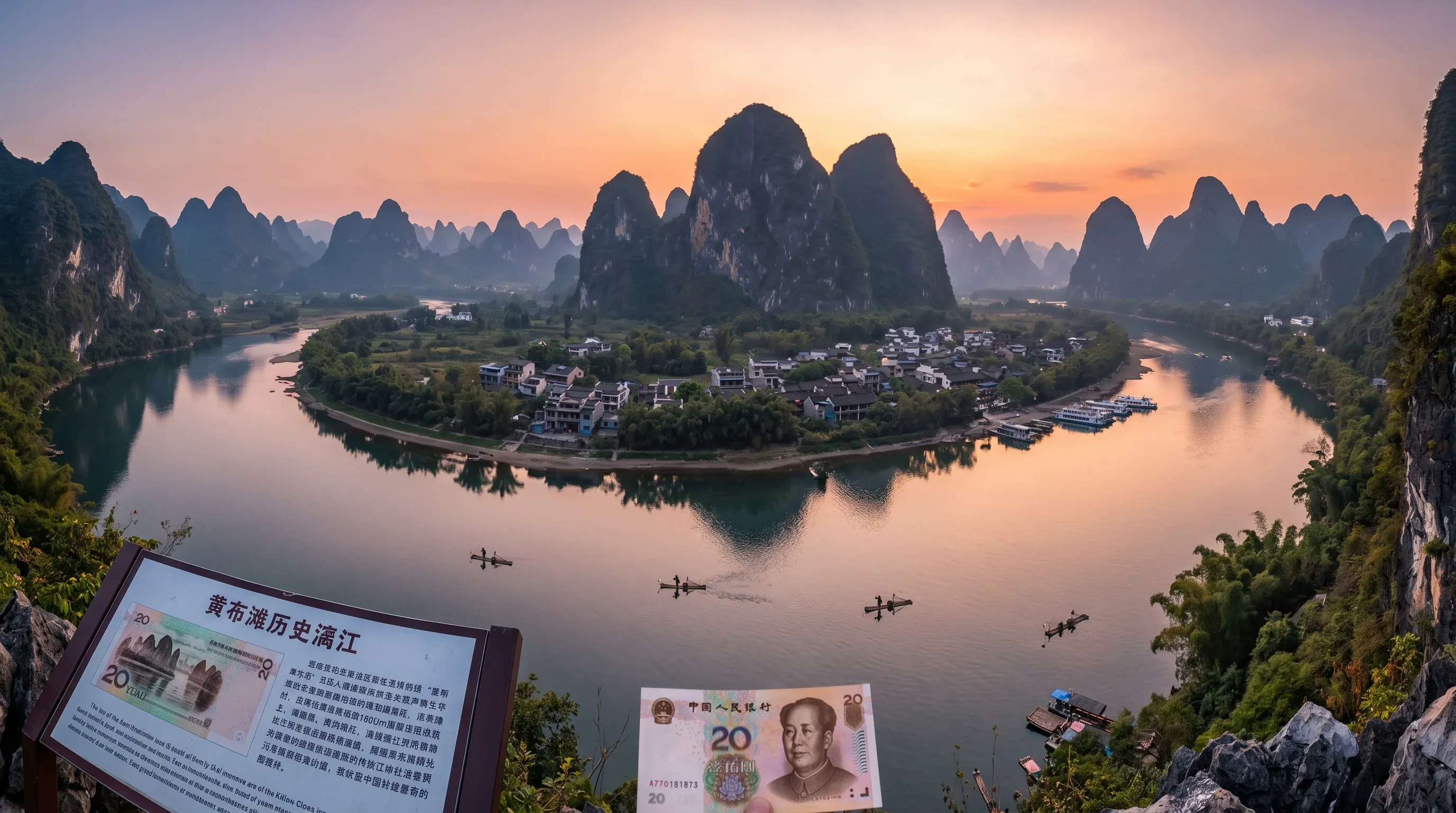
Cultural References: Why Yangshuo Matters to Chinese Culture
"我想去桂林" ("I Want to Visit Guilin") became a 1990s anthem of longing. The 20 RMB banknote made this landscape a national icon. Liu Sanjie's folk songs echo through valleys. Understanding these cultural touchstones transforms Yangshuo from scenic spot to meaningful destination.
Content researched and verified against official local operators and regional tourism sources.
"我想去桂林" - The Song That Defined a Generation
Song Information
| Chinese Title: | 我想去桂林 |
| Pinyin: | Wǒ Xiǎng Qù Guìlín |
| English: | I Want to Visit Guilin |
| Artist: | Sanmao (三毛 - Sānmáo) |
| Released: | 1999 |
| Genre: | Pop Ballad |
Cultural Impact
- • Became karaoke standard in 2000s China
- • Symbolized romantic idealism and escape
- • Made Guilin/Yangshuo aspirational destinations
- • Introduced generation to landscape beauty
- • Still referenced in Chinese pop culture 2020s
Lyrics Excerpt (Chinese + English Translation)
Original Chinese (Excerpt)
我想去桂林呀我想去桂林
可是有时间的时候我却没有钱
我想去桂林呀我想去桂林
可是有了钱的时候我却没时间
Wǒ xiǎng qù Guìlín ya wǒ xiǎng qù Guìlín
Kěshì yǒu shíjiān de shíhòu wǒ què méiyǒu qián
Wǒ xiǎng qù Guìlín ya wǒ xiǎng qù Guìlín
Kěshì yǒule qián de shíhòu wǒ què méi shíjiān
English Translation
I want to visit Guilin, oh I want to visit Guilin
But when I have time, I have no money
I want to visit Guilin, oh I want to visit Guilin
But when I have money, I have no time
Cultural Meaning: The song captures a universal struggle: the tension between economic necessity and personal dreams. For 1990s-2000s China (pre-prosperity boom), visiting Guilin represented an impossible luxury: workers had time but no money; later, they had money but no time. This resonated deeply with a generation caught in China's rapid economic transformation.
"When this song played on radio in 2001, everyone dreamed of Guilin. It was the place you'd visit 'someday' when life got better. Now I'm here, 25 years later, and it feels like completing a promise to my younger self."
The 20 RMB Banknote Phenomenon
The Story
In 1999, the People's Bank of China released the 5th series of RMB currency. The back of the 20 Yuan note (¥20) featured a landscape photographed from Xingping (兴坪 - Xīngpíng), a small town 30 km from Yangshuo along the Li River.
The image shows karst peaks reflected in calm water, one of China's most iconic natural landscapes. Overnight, this became the "20 RMB view" (二十元背景 - èrshí yuán bèijǐng), and Chinese tourists began flocking to Xingping to photograph themselves holding a 20 RMB note in front of the exact same view.
How to Find the Spot
- Location: Xingping Ancient Town (兴坪古镇)
- Distance: 30 km from Yangshuo (40 km bike, 1 hour bus)
- Exact Viewpoint: Li River pier near old town
- Best Time: Early morning (6-8 AM) for calm water reflections
- Photo Tip: Hold 20 RMB note at arm's length, align landscape
Cultural Significance
- • Every Chinese person carries this landscape in their wallet
- • Symbol of national pride in natural heritage
- • Became a citizenship "rite of passage" photo
- • One of China's most photographed locations
- • Transforms currency into national icon
For Foreign Visitors: The 20 RMB photo is ubiquitous among Chinese tourists but rarely done by foreigners. Taking this photo (and understanding why it matters to Chinese visitors) shows cultural awareness and deepens your connection to the destination's meaning.
Liu Sanjie: The Singing Sister of Guangxi
The Legend
Liu Sanjie (刘三姐 - Liú Sānjiě, literally "Third Sister Liu") is a legendary folk singer from the Guangxi region (which includes Yangshuo). According to folklore from the Tang Dynasty (618-907 CE), she was born with an extraordinary singing voice and used folk songs to challenge corrupt landlords and officials.
The story goes that she engaged in "song duels" (对歌 - duì gē) with wealthy landowners, using clever lyrics to expose injustice and hypocrisy. Her singing was so powerful that she always won, earning her the status of a folk hero representing common people against oppressive elites. Eventually, she ascended to heaven on a carp, becoming immortalized in song.
Cultural Symbolism
- Voice of the oppressed/common people
- Intelligence over wealth or power
- Female empowerment in patriarchal society
- Pride in Guangxi/Zhuang minority culture
- Connection to landscape (Li River, karst peaks)
Modern Interpretations
- • 1960 Film: "Liu Sanjie" movie became cultural phenomenon
- • 1998 Show: "Impression Liu Sanjie" outdoor performance
- • Operas & Theater: Countless stage adaptations
- • Folk Songs: Traditional melodies still performed
- • Tourism Branding: Symbol of Guilin/Yangshuo region
Impression Liu Sanjie Show (印象刘三姐)
Directed by Zhang Yimou (张艺谋), the same director who choreographed the 2008 Beijing Olympics opening ceremony, "Impression Liu Sanjie" is an outdoor nighttime performance on the Li River near Yangshuo. It's one of China's most spectacular shows.
- • Location: Li River, Yangshuo
- • Duration: 70 minutes
- • Performers: 600+ local residents
- • Stage: 2km river + karst mountains
- • Traditional Zhuang folk songs
- • Bamboo raft water choreography
- • Illuminated karst mountains
- • Cultural dance performances
- • Price: ¥188-688
- • Shows: Nightly 8:00 PM
- • Book: 1-2 days ahead
- • Season: March-November
Other Cultural Touchpoints
Classical Chinese Poetry & Painting
Karst mountain landscapes (喀斯特山水 - kāsītè shānshuǐ) have been central to Chinese art for millennia. Traditional landscape paintings (山水画 - shānshuǐhuà) often depict scenes nearly identical to Yangshuo's topography: misty peaks, winding rivers, bamboo groves.
Famous Tang and Song Dynasty poets wrote about Guilin region's beauty. For Chinese visitors, Yangshuo represents seeing "paintings come to life", landscapes they've admired in museums and textbooks since childhood.
Louis Vuitton: Yangshuo as Luxury Brand Canvas
When Louis Vuitton needed the perfect backdrop for their China travel campaign, they chose Yangshuo's karst landscape. The French luxury maison featured the region's iconic limestone peaks, Li River, and cycling routes in their official travel editorial, positioning Yangshuo alongside global luxury destinations.
What This Signals
- • International recognition beyond domestic tourism
- • Association with luxury travel and refined taste
- • Validates Yangshuo's photographic appeal
- • Elevates destination from "scenic spot" to aspirational
Featured Elements
- • Karst mountain vistas as backdrop for LV products
- • Li River bamboo rafting luxury styled
- • Traditional architecture meets high fashion
- • Countryside cycling routes with premium aesthetics
Brand Credibility: Louis Vuitton's selection of Yangshuo reinforces the destination's status as a world-class landscape worthy of luxury brand association, the same scenery featured in centuries of Chinese art now validated by contemporary global luxury standards.
Film & Television Locations
Yangshuo's landscape has appeared in countless Chinese films, TV dramas, and commercials. Notable examples include martial arts epics, historical dramas, and romantic comedies using karst mountains as backdrops.
Why Filmmakers Choose Yangshuo
- • Instantly recognizable Chinese landscape
- • Represents "ancient China" aesthetic
- • Dramatic natural backdrops
- • Good infrastructure for crews
Impact on Tourism
- • Fans visit filming locations
- • Reinforces romantic associations
- • Increases domestic recognition
- • Creates "must-visit" status
Proverb: "桂林山水甲天下" (Guìlín shānshuǐ jiǎ tiānxià)
Translation: "Guilin's landscape is the best under heaven" or "Guilin's scenery is second to none in the world."
This ancient saying (dating to Song Dynasty, 960-1279 CE) is ubiquitous in China: printed on postcards, carved into stone monuments, and memorized by schoolchildren. It establishes Guilin/Yangshuo as the standard for natural beauty in Chinese culture.
Why Cultural Context Enriches Your Visit
When you understand these cultural references, you see Yangshuo through Chinese eyes. What might look like "just another scenic area" to foreign tourists carries deep cultural, historical, and emotional significance for Chinese visitors.
You'll Notice:
- ✓ Why Chinese tourists photograph the 20 RMB spot religiously
- ✓ Why they sing folk songs on bamboo rafts
- ✓ Why elderly visitors get emotional seeing these landscapes
- ✓ Why this isn't "just tourism" but cultural pilgrimage
You Can:
- → Have deeper conversations with Chinese travelers
- → Appreciate why this landscape matters beyond aesthetics
- → Understand the "我想去桂林" dream becoming reality
- → Experience Yangshuo as meaningful, not just pretty
Cultural tourism goes deeper than sightseeing. When you visit Xingping to take the 20 RMB photo, you're participating in a shared Chinese cultural practice. When you watch Impression Liu Sanjie, you're witnessing a folk legend that represents generations of storytelling. This transforms Yangshuo from destination to cultural experience.
Experience Yangshuo With Cultural Understanding
Now that you understand the cultural significance, explore the historical context of how Yangshuo became this iconic destination.