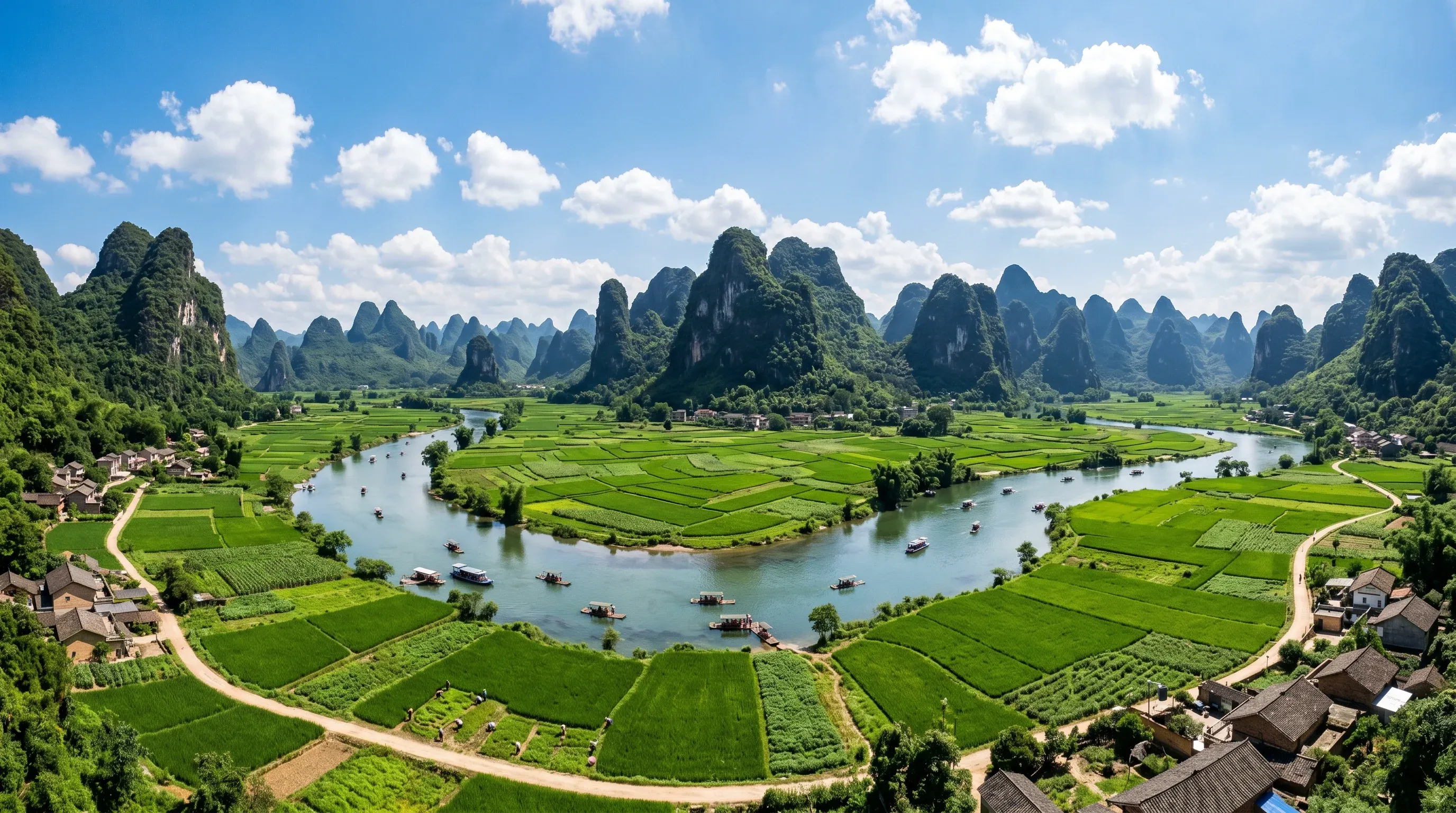
20 Unforgettable Things to Do in Yangshuo
Yangshuo isn't just a destination; it's a feeling. Between the thousands of karst peaks lie secrets that most tourists miss. We've curated the ultimate mix of must-see icons, adrenaline adventures, and hidden local gems.
China Travel Update (2026): Attractions open as normal. Visa-free travel for 30+ countries makes visiting easier than ever.
Content researched and verified against official local operators and regional tourism sources.
Important Disclaimer
The travel information, prices, and recommendations provided in this guide are subject to change without notice. We strongly recommend verifying all details with local authorities, official tourism offices, and service providers before making travel arrangements.
Always verify: Contact local tourism offices, government agencies, hotels, tour operators, and transportation providers directly for current prices, availability, regulations, and safety information. VisitYangshuo.com is not liable for any inaccuracies, outdated information, or decisions made based on the content provided on this website.
Some of these spots get crowded and commercial. For the full honest picture, read why Yangshuo is worth visiting
Quick Summary: Yangshuo Highlights
Yangshuo offers a blend of relaxation and adventure. Must-Do: Bamboo rafting on the Yulong River (no motors). Best View: Sunrise at Xianggong Mountain. Culture: Impression Liu Sanjie night show. Activities: Rock climbing at Moon Hill, cycling the Ten-Mile Gallery, and exploring Silver Cave. Hidden Gem: The TV Tower viewpoint for a 360-degree town view.
Most travel guides send you to West Street and the Big Banyan Tree. While those are fine, the real magic of Yangshuo happens when you wake up at 5 AM for a sunrise, or drift down a quiet tributary of the Yulong River.
We have ranked these experiences based on value, uniqueness, and 'wow' factor. Whether you're a climber, a foodie, or just looking for that perfect Instagram shot, here is your checklist.
Ruyi Peak Scenic Area
One of Yangshuo's newest and most spectacular attractions. You take a scenic cable car up to the karst peaks, walk across a stunning suspension bridge covered in traditional red wish ribbons, and navigate the famous glass-bottom plank road bolted to the side of a sheer cliff.
"If you have a severe fear of heights, the glass-bottom walkway might be a major challenge, but the views of the karst landscape from the top are arguably the best in the entire region. Go early to beat the massive tour groups."
Yulong River Bamboo RaftingView Full Guide
The quintessential Yangshuo experience. Unlike the motorized rafts on the Li River, these traditional bamboo rafts are hand-poled by local boatmen. You'll drift peacefully past ancient stone bridges, lush rice paddies, and dramatic karst peaks. It's the serenity you came to China to find.Read our complete 2026 Bamboo Rafting Guide
"Choose the 'Jinlong Bridge to Jiuxian' route (1.5 hours). It's the most scenic, has fewer crowds, and passes the legendary Dragon Bridge. Avoid the short, touristy routes near the main road."
Xianggong Mountain
For years, this was a secret spot known only to local photographers. Now, it offers arguably the single best panoramic view of the Li River bend and the karst peaks. The sunrise here is world-famous, painting the sea of clouds and mountains in shades of gold and purple.
"Arrive at least 45 minutes before sunrise to secure a tripod spot on the main deck. If you miss sunrise, sunset is also spectacular and much quieter. There is a small coffee shop on the roof with great views!"
Moon Hill
A limestone peak with a natural moon-shaped arch that changes phase as you view it from different angles, reached by a climb through a bamboo forest up to the arch itself.
"Opening status and admission price have been inconsistent through 2025-2026 due to a reported operator dispute. Verify current access and price locally or with your accommodation before planning your visit."
West Street (Xi Jie)
The heartbeat of Yangshuo. This 1,400-year-old marble-paved street transforms from a sleepy heritage walk in the morning to a neon-lit carnival at night. It's a chaotic, vibrant mix of ancient architecture, souvenir shops, beer fish restaurants, and nightclubs.
"The main street is a tourist trap. Duck into side alleys for quieter cafes. Crucial photo tip: the ONLY time to capture the traditional Ming/Qing architecture without thousands of tourists in the background is between 07:00 and 08:30 in the morning. At night, it is a neon-lit carnival."
Rock Climbing
Yangshuo is the rock climbing capital of Asia, boasting over 1,000 routes on high-quality limestone. Whether you are a complete beginner or a 5.14 pro, there is a crag for you. The views from the wall, hanging above the village and rice fields, are unmatched.
"Beginners should head to 'Swiss Cheese' or 'Wine Bottle' crags. Always hire a certified guide (like Karst Climber or Black Rock) for safety. The best climbing season is autumn (Sept-Nov) when it's cool and dry."
TV Tower Viewpoint
The highest accessible point in Yangshuo town. This is a 'wild' hike (paved but steep) leading to a transmission tower. The 360-degree view from the top is superior to Yangshuo Park and far less crowded. You can see the entire layout of the town and the Li River.
"The gate at the top is sometimes locked, but the view from just below is still 95% as good. Bring a torch/headlamp if you plan to stay for sunset: the descent is unlit and pitch black."
Laozhai Hill (Xingping)
Located in Xingping, this steep climb offers the famous 'bird's eye view' of the Li River curve that photographers dream of. It is a more rugged and adventurous climb than the others, with a ladder section near the top.
"This is THE sunset spot. However, never climb this on a weekend or public holiday! The steep, narrow paths get dangerously crowded, turning a 1-hour hike into a 3-hour ordeal. Be careful on the descent; the steps are slippery when wet."
20 Yuan Banknote Spot
The most famous currency view in the world. This is the exact perspective of the Li River printed on the back of the 20 Yuan note. It's located just a short walk from Xingping Ancient Town.
"The official platform is always crowded. Walk about 200 meters further along the riverbank (away from town) to find a quiet spot on the pebble beach. The angle is almost identical, and you can get right to the water's edge."
Longji Rice Terraces
Although a 2.5-hour drive away, this is the #1 day trip from Yangshuo. The 'Dragon's Backbone' terraces are a feat of ancient engineering, carved into the mountains 650 years ago. The layered fields change color with the seasons and are home to the minority Yao and Zhuang people.
"Visit the 'Ping'an' section for accessibility or 'Dazhai' for a cable car option. Try the 'Bamboo Rice' cooked over a fire by local grandmas, it's delicious! Best months: May (water filled) or October (golden harvest)."
Xingping Ancient Town
Compared to the commercialized West Street, Xingping still retains some of its old-world charm. With over 1,700 years of history, the stone streets, temples, and preserved Ming/Qing dynasty buildings feel like a time capsule.
"Don't just walk the main souvenir street. Visit the old opera stage 'Guan Di Temple'. Also, the coffee shops here (like 'Old Street Cafe') have a more relaxed vibe than Yangshuo. Great base for 1 night."
Silver Cave
Yangshuo dominates the 'karst' landscape, which means caves. Silver Cave is the largest and most impressive commercial cave. It's a subterranean cathedral of stalactites and stalagmites, illuminated by colorful (sometimes disco) lights.
"It IS touristy and the lights are garish, but the sheer scale of the formations is undeniable. The 'Music Stone Screen' and 'Moon Reflection' are the highlights. Good rainy day backup plan."
Countryside Sidecar Tour
Feel like Indiana Jones exploring the backroads in a vintage Commune-era motorcycle sidecar. This is the coolest way to see the 'real' villages, dirt paths, and hidden valleys that buses and cars can't reach.
"Ask for a 'custom route' to avoid the main roads completely. The drivers usually know secret swimming spots and old farmhouse restaurants. It's a bit pricey but worth every yuan for the memories."
Ten Mile Gallery
A 10-mile stretch of road flanked by towering peaks, flower fields, and attractions like the Big Banyan Tree. It used to be chaotic with traffic, but is now a dedicated shuttle/bike lane, making it safer and more pleasant.
"Rent an E-bike (electric scooter) instead of a pedal bike. The wind in your hair is unbeatable, and you can cover more ground. Stop at the 'Gongnong Bridge' for the classic view of bamboo rafts passing under."
Cooking Class
Yangshuo food is unique: spicy, sour, and fresh. Taking a cooking class is the best souvenir you can bring home. Most schools include a market tour where you learn to identify strange local vegetables and bargain like a local.
"Yangshuo Cooking School in Chaolong village offers classes in a traditional farmhouse surrounded by fields. You'll usually learn to make Beer Fish, Eggplant heavy with garlic, and stuffed pumpkin flowers."
Yangshuo Park
For a glimpse of authentic local life, head here. It's not a big tourist attraction, which is exactly why it's charming. You'll see grandpas playing cards, women square dancing, and kids playing.
"Go at 7:00 AM. This is when the park is most alive with locals doing Tai Chi, sword dancing, and Qigong. Climbers: there is a small crag inside the park that is free to climb!"
Impression Sanjie Liu
Directed by Zhang Yimou (who did the Beijing Olympics opening), this is the largest natural theater in the world. The stage IS the Li River, and the backdrop IS the 12 lighted peaks. With 600 performers, it’s a spectacle of light and sound.
"Don't buy the most expensive seats (Area A). The 'B2' seats (regular seats) actually offer a better panoramic view of the formations. Book tickets through your hotel for a discount, never at the gate."
Seven Stars Tea Plantation
Drive 20 minutes out of town to find rolling hills covered in neat rows of tea bushes. It's a quiet, green escape. You can put on a bamboo hat, pick your own tea leaves, and learn the tea ceremony.
"The tea grown here is 'Green Tea' style. The view from the top of the tea hill is a fantastic and unusual perspective of the karst peaks rising out of the green bushes. Great drone spot."
Brother's Cave
Unlike Silver Cave, this has no neon lights and no paved paths. It is a 'wild' cave experience. You might need to crawl a bit, get muddy, and swim in a mud bath. It is raw, real adventure.
"You absolutely need a guide for this. Do not attempt to find it alone. Most hostels can organize a 'cave & mud bath' tour. Wear clothes you don't mind destroying."
Rice Paddies Walking
Sometimes the best thing to do is just walk. The path along the Yulong River (away from the road) takes you right through the functioning rice paddies. In spring, they are mirrors; in summer, electric green; in autumn, golden waves.
"Start at the 'Jiuxian' ancient village and walk south toward the 'Dragon Bridge'. It is the quietest section. Bring mosquito spray if walking near sunset."
Cormorant Fishing
A tradition dating back 1,300 years. Fishermen on bamboo rafts use trained cormorant birds to dive and catch fish. The birds return to the raft and spit the fish into the basket. It's a dying art.
"Be aware: today, this is mostly a performance for tourists rather than a livelihood. However, watching the gas lamp-lit rafts on the dark river with the old fisherman is incredibly atmospheric and photogenic."
Shiwai Taoyuan (Secret Garden)
A hidden gem located along Guiyang Road that offers a unique blend of natural beauty and cultural heritage. This scenic area recreates the legendary 'Peach Blossom Spring' with traditional architecture, lush gardens, and calm waters.
"The entry ticket includes a guided boat ride along the river where you can see folk performances and traditional farming scenes. It's a fantastic, less-crowded alternative to the main tourist hubs."
Unlock Yangshuo’s Best-Kept Experiences
Don’t get stuck in crowded tour buses or miss sold-out river tickets. Handpick your favorite adventures, bundle them into one seamless day, and let our verified English-speaking Yangshuo host arrange every detail.
Common Questions About Yangshuo
What are the top 3 things to see in Yangshuo?
If you are short on time, prioritize: 1) Bamboo Rafting on the Yulong River, 2) The sunrise view from Xianggong Mountain, and 3) The Impression Liu Sanjie night show.
Is West Street worth visiting?
West Street is worth a quick visit for the history and atmosphere, but it is very commercialized. We recommend staying in the quieter villages nearby (like beautiful riverside hotels) and just visiting West Street for an evening meal.
Can I swim in the Li River?
Swimming in the main Li River channel is dangerous and generally prohibited due to boat traffic. However, there are clean, quiet swimming spots along the Yulong River tributaries, ask your guesthouse for the 'secret beach' locations.
Where is the best place to watch sunrise or sunset in Yangshuo?
For sunrise, go to Xianggong Mountain and arrive at least 45 minutes early to claim a spot on the main deck. For sunset, Laozhai Hill in Xingping gives the classic view of the river bend, but skip it on weekends and holidays. Closer to town, try the TV Tower, and bring a torch for the unlit descent.
Put Your Business on the Map of VisitYangshuo.com
Reach our local, national, and international visitors daily who are actively looking for restaurants, shops, and activities in VisitYangshuo.com. Choose one of our advertising packages:
Basic
¥1688 /yr
€199 /yr *
- Standard listing with logo, contact info, and link to your website
- Short description up to 100 words
- Findable in 1 relevant category
- Maximum 2 photos
Premium
¥3888 /yr
€499 /yr *
- Everything in the Basic package
- Priority position in your category (above Basic)
- Extensive showcase section with photo gallery (up to 10 photos)
- Direct WeChat and booking buttons
Partner
¥6888 /yr
€999 /yr *
- Everything in the Premium package
- Exclusive banner rotation on overview pages
- Prominent listing on the homepage (all language versions)
* The ¥ price shown is our set listing price, chosen as a round number that avoids the digit 4 (a homophone for "death" in Mandarin, considered unlucky in Chinese business culture). The EUR amount below it is the only official, binding price, charged via PayPal or Wise at the exchange rate applicable on your payment date.